An advanced engineering analysis on evaluating suspension repair value in 2026. Discover how GJBUSH delivers Tier-1 NVH performance, 1-million-cycle fatigue durability, and zero-defect rubber-to-metal bonded solutions for global OEMs.
GJBUSH delivers an advanced engineering analysis on evaluating suspension repair value and total cost of ownership in 2026. When rubber-to-metal chassis isolators succumb to mechanical fatigue, multi-axial kinetic instability severely compromises vehicle safety, tire longevity, and Noise, Vibration, and Harshness mitigation. By leveraging a forty-year compounding database, fully automated phosphating lines, and relentless one-million-cycle fatigue validation, GJBUSH provides global Original Equipment Manufacturers and Supplier Quality Engineers with high-durability anti-vibration solutions that eliminate premature field failures.
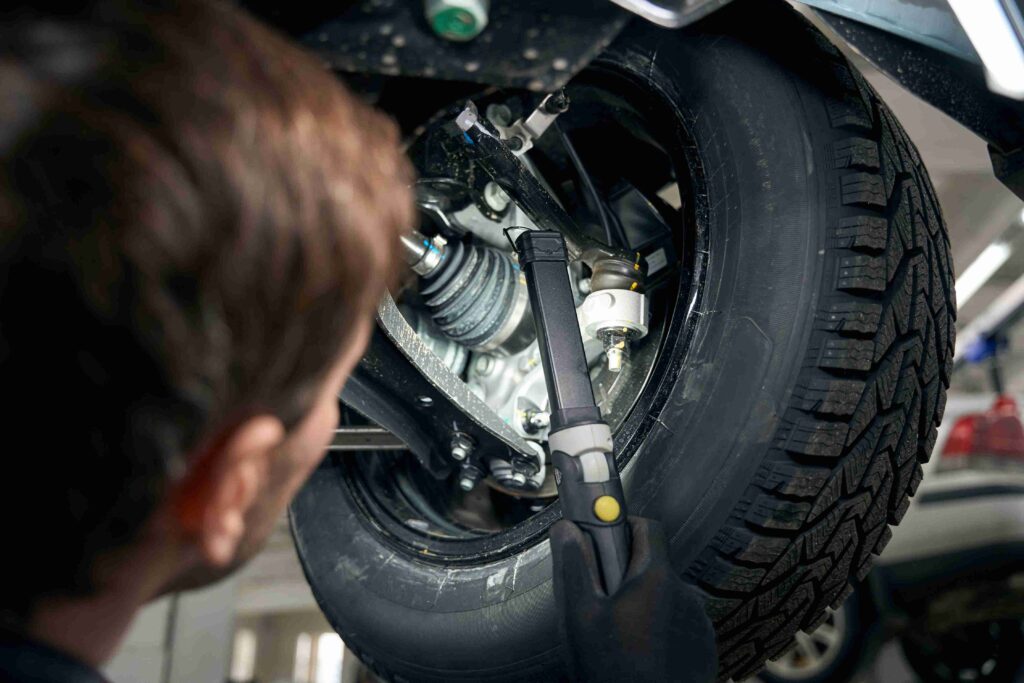
1 How Do You Know If Your Car Suspension Is Bad?
The degradation of an automotive suspension system rarely occurs as an instantaneous structural snap; rather, it is a progressive deterioration of elastomeric cross-linking density and surface bond integrity under continuous mechanical fatigue. Supplier Quality Engineers and fleet maintenance managers must monitor specific acoustic and kinetic signatures to diagnose chassis degradation. Symptoms such as low-speed chassis clunking during braking reversals, erratic steering wander on level highways, and accelerated inner-shoulder tire cupping indicate that the internal rubber matrix of the control arm bushings or strut mounts has hollowed out. Under severe multi-axial loads, worn isolators permit unwanted parasitic deflection, causing dynamic caster and toe drift. At GJBUSH, we diagnose these field failure modes during reverse engineering and failure analysis by utilizing our fully equipped in-house laboratory. By analyzing returned components with profile projectors, electronic tensile testers, and dynamic stiffness testers, we pinpoint the exact stress thresholds that trigger rubber tearing or bond delamination, enabling us to re-engineer optimized replacement architectures.
2 Is Car Suspension Repair Worth the Investment?
Evaluating the economic justification for suspension repair requires an engineering-centric total cost of ownership analysis rather than a simple assessment of upfront component purchase price. Deferring the replacement of degraded suspension joints transfers unmitigated kinetic shock directly into higher-value structural assemblies, such as subframe clevis mounts, steering rack assemblies, and shock absorber internal valving. When executed using premium rubber-to-metal bonded products, suspension repair is an essential investment that restores factory vehicle dynamics and prevents secondary mechanical damage. GJBUSH ensures that this investment yields permanent structural reliability. We deploy an advanced production hardware matrix featuring multiple 400T bushing vulcanizing machines that apply uniform, high-tonnage thermodynamic pressure across the mold matrix. This precise thermal curing establishes an unbreakable molecular bond, ensuring that the restored chassis performs flawlessly under severe multi-axial stress without requiring repetitive workshop labor.
3 Model-Specific Insights: From Subaru to Toyota
Suspension topologies vary significantly across global automotive platforms, meaning generic, uncalibrated replacement parts introduce severe handling anomalies. For example, the Symmetrical All-Wheel Drive architecture of a Subaru platform relies on trailing arm and control arm bushings engineered with specific longitudinal compliance to absorb drive torque shocks without inducing rear-axle wheel hop. Conversely, a Toyota Global Architecture platform utilizes highly rigid lower control arm pivots to prioritize sharp lateral response and precise steering feedback. GJBUSH accommodates these radically different structural demands through our proprietary 40-year rubber formula database and flexible CNC machining lines. This engineering flexibility allows us to rapid-prototype and mass-produce custom inner crush tubes, outer sleeves, and elastomeric Shore hardness profiles with micron-level dimensional accuracy, ensuring that every replacement component perfectly aligns with the original platform kinematics.
4 The Hidden Savings: Why Fixing Your Suspension Saves Money
Procurement teams and vehicle operators frequently overlook the compounding financial losses caused by driving on compromised suspension joints. A single failed control arm bushing allows dynamic toe angle fluctuations, which rapidly destroy a set of premium tires within a fraction of their intended mileage. Furthermore, excessive chassis movement creates parasitic drag, noticeably increasing fuel or electrical energy consumption in modern electric vehicles. Unmitigated road shock also propagates into the cabin, accelerating the wear of interior trim fasteners and delicate electronic sensor modules. By installing original-equipment-grade replacement components, vehicle owners capture substantial hidden savings. GJBUSH guarantees exceptional component longevity across every product line. Every heavy-duty architecture we design must survive a rigorous 1-million-cycle fatigue test on our multi-axial test rigs, translating to a proven zero percent failure rate within 100,000 kilometers under severe real-world operational conditions.
5 FAQ For Suspension Parts
When evaluating suspension components, Supplier Quality Engineers and procurement professionals frequently raise technical questions regarding material verification, environmental resistance, and dynamic testing protocols. A primary concern is how to ensure that replacement elastomers resist premature hardening and micro-fissuring caused by atmospheric exposure. At GJBUSH, all raw rubber formulations undergo strict pre-production validation using computerized rheometers and Mooney viscometers to verify polymer cross-linking potential. Furthermore, our finished products are placed inside specialized ozone and aging test chambers alongside salt spray test chambers to verify complete immunity against atmospheric ozone, extreme thermal cycles, and petroleum-based chassis degreasers. Another common technical inquiry addresses dynamic stiffness consistency. GJBUSH evaluates batch-to-batch dynamic stiffness using advanced laboratory test rigs, guaranteeing that the dynamic-to-static stiffness ratio remains strictly within original equipment limits to prevent cabin drone.
6 Why GJBUSH is the Specialist You Need
Securing a zero-defect supply chain for critical suspension parts requires partnering with a source manufacturer equipped with deep research and development capabilities and automated industrial hardware. GJBUSH provides an unyielding technical advantage built upon forty years of bushing development experience and twenty-eight years of manufacturing history. We possess the Tier-1-level capability to participate in joint NVH performance R&D for complete vehicles, combining robust finite element Computer-Aided Engineering analysis with empirical testing data. To permanently eliminate subsurface delamination, we process all metallic substrates through fully automatic gluing, shot blasting, and phosphating lines before vulcanization. Operating under SGS-certified IATF 16949 and ISO 14001 quality frameworks, alongside validation by the China Automotive Technology and Research Center, GJBUSH boasts an annual capacity exceeding 10 million pieces, providing strong rapid-expansion capabilities for large global orders.
7 Conclusion
Restoring an automotive suspension system should never be viewed as an avoidable maintenance expense, but rather as a vital restoration of kinetic safety, vehicle control, and ride refinement. Installing substandard anti-vibration joints inevitably exposes vehicle platforms to handling instability and elevated warranty liabilities. By integrating four decades of elastomeric compounding mastery with state-of-the-art automated manufacturing hardware, GJBUSH delivers Tier-1 isolation solutions engineered to thrive in the most punishing global environments. Supported by our comprehensive laboratory validation and flawless mass production, we stand ready to keep global chassis systems silent, stable, and structurally sound.
How does GJBUSH prevent rubber-to-metal delamination in heavy-duty suspension bushings?
Preventing delamination demands complete removal of surface oxides and unyielding thermodynamic control during molding. GJBUSH routes all metal sleeves through fully automatic shot blasting and chemical phosphating lines to establish a pristine, highly reactive microscopic bonding matrix. Following automated adhesive application, our multiple 400T bushing vulcanizing machines inject uniform heat and high tonnage pressure across the mold, creating an unbreakable molecular bond where the chemical adhesion strength surpasses the physical tear threshold of the raw elastomer.
Why is joint NVH performance R&D capability essential when selecting a suspension bushing supplier?
A suspension bushing is a active dynamic isolator, not a passive rubber insert. A supplier must understand how elastomeric dynamic stiffness interacts with overall chassis resonance. GJBUSH possesses the Tier-1-level capability to participate in joint NVH performance R&D for complete vehicles. Utilizing computer-aided engineering simulations alongside empirical data from our dynamic stiffness testers and torsion rigs, our engineers optimize internal void geometries and Shore hardness parameters to suppress chassis shudder and road noise before mass production tooling is finalized.
What specific testing protocols guarantee that GJBUSH suspension components achieve a 100,000-kilometer service lifespan?
To guarantee long-term fatigue resistance and protect global OEMs from field recalls, GJBUSH subjects every heavy-duty component architecture to a strict 1-million-cycle fatigue test under fully reversing dynamic loads within our IATF 16949 accredited laboratory. We supplement fatigue testing with electronic tensile evaluations, Rockwell hardness verification, and accelerated ozone aging tests, ensuring a proven zero percent failure rate within 100,000 kilometers of severe real-world service.